Friday, June 16, 2017

The Gravois

Gravois at Jefferson, looking northeast, in its previous six-lane configuration.


Note: This goofy poem tells the story of a very cool grassroots effort called the Greater Gravois Initiative, which advocated successfully to make Gravois road a better place for people. I highly recommend you read more on the effort here.


The Gravois

On the South side of town
And curving toward West
Is a long winding thoroughfare that seldom does rest
A rumbling road that the neighbors detest.

It’s the street called the Mighty Gravois.

Now come a bit closer and sit at my knee boy
I’ll tell you the tale and I’ll make it quite quick
Of a momentous feat that few would predict
I’ll tell you the taming of the Mighty Gravois.

An asphalt behemoth, a bustling beast
Funneling cars to the North the South West and East
Like a concrete river
It carved a curved path
Through historic neighborhoods it cuts a wide swath.

And they cars they did love it
It’s not hard to see why
The street was built for their comfort
It was built six lanes wide!

So the semi-trucks trucked and the convertibles cruised
And speed limit signs were ignored and abused
Where they were going well that we don’t know
We just know they were going and they’d go go go go!

The crosswalks were few and appeared only rarely
And to try to use them could prove quite scary
Among bicyclists only the most intrepid breed
Would hazard the cars and their harrowing speed.

But one day a question came from the grassroots
From walkers who walk and scooters that scoot
From small businesses too quickly passed by
From neighborhoods split by the Gravois divide  
From parents with strollers and bussers who bus
 “Well why can’t this road be also for us?!?!”


Small businesses along Gravois. Pedestrian-oriented commercial buildings can struggle along high-speed roads. 


And so began efforts to create a new plan
Of crosswalks and bike lanes and places to stand
And lanes for the cars of course they’re still there
With restrictions in place that they’ll just have to bear.

Unused to this challenge oh MODOT did wail
“We’ve been trained to use hammers why can’t we just nail?”
But this broad coalition continued their stand
And re-explained concepts like induced demand.

And against all odds a new road appeared
And showed that MODOT overcame their old fears
A road on which people can walk, bike, and survive
Restricted from six lanes, it now counts just five!

Grumps predicted confusion and traffic kerfuffles
And cars moving along at barely a shuffle
But to their surprise if not their delight
Even at rush hour the cars are alright.

Sure, it could be better I have to admit
The bike lanes often just suddenly quit
Car speeds are still reckless especially at night
But the improvement is major not merely just slight.

So heed my words now that I’ve told you this story
The champions for change have sure earned their glory
It’s cause for celebration but there’s no time for rest
We’ve tamed the Mighty Gravois now which road is next? 

Gravois at Jefferson, looking northeast, in its new configuration. A lane of traffic was removed in each direction, and replaced with bike lanes and a center turn lane. The road now also has several "zebra crosswalks" that increase pedestrian visibility. 


Thursday, June 8, 2017

Another Side of St. Louis' Startup Story

The St Louis region has garnered a lot of attention for its startup scene. In the past year, the Washington Monthly has called St. Louis an “entrepreneurial boomtown,” while FiveThirtyEight dubbed it the “New Startup Frontier.” While it can be difficult to separate truth from hype when it comes to amorphous topics like innovation and entrepreneurship, it appears that something very real and very positive is happening. Attention tends to be directed towards a relatively narrow subset of firms. The Washington Monthly article used tech, bioscience, and craft beer firms as examples to establish St. Louis’ startup bona fides. These are the types of firms that often dominate the startup conversation, which can reinforce a conception of entrepreneurship as typically young, white, and male. Data on business starts in St. Louis suggest that this is not the case. In fact, Black-owned firms account for the majority of new firm starts in St. Louis. This incredible growth in Black-owned firms demands further investigation into what is happening to drive such growth, and what can be done to leverage this entrepreneurial activity as a community asset.


Black-Owned Businesses Driving Growth in Startups
So what do we know about Black-owned firms in St. Louis? Not as much as we’d like, but enough to know that something significant is happening. The Census Survey of Business Owners (SBO) includes “all nonfarm businesses filing Internal Revenue Service tax forms as individual proprietorships, partnerships, or any type of corporation, and with receipts of $1,000 or more.” This survey population does not include informal enterprises but is otherwise fairly comprehensive. The Census completes the SBO every five years, and the most recent data available is from 2012. Although somewhat old, the data on firm growth in St. Louis City paint a dramatic picture:  

The City saw the total number of firms increase 27% between 2007 and 2012. Disaggregating this into racial groups reveals highly uneven growth. White-owned firms outnumbered Black-owned firms by more than 3 to 1 in 2007, but Black-owned firms grew more rapidly in the subsequent five years, nearly doubling their overall number. The City’s impressive growth numbers are largely thanks to these Black-owned firms: of the 6,408 new firms formed between 2007 and 2012, over 75% of them were owned by Blacks or African Americans. This represents stunning growth in the number of Black-owned firms.

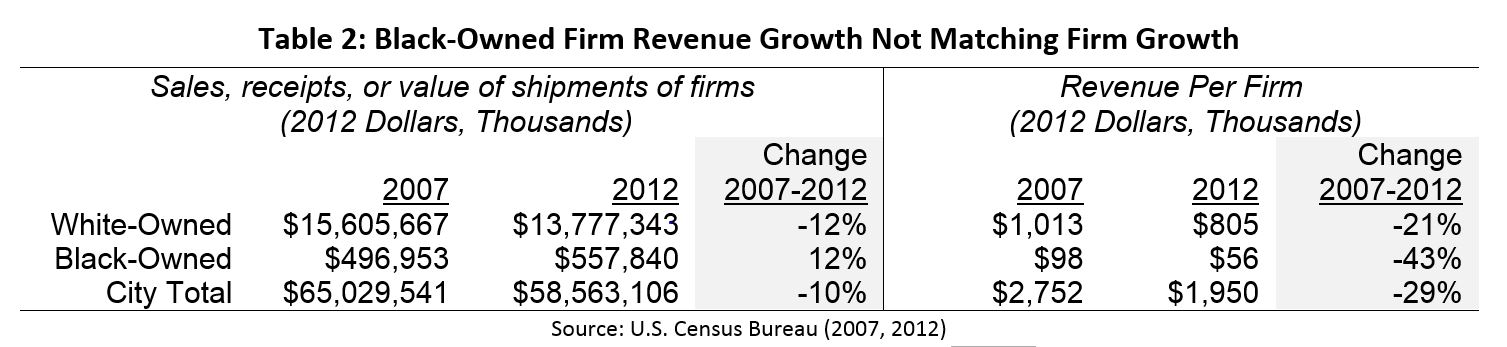
This growth indicates a tremendous amount of entrepreneurial activity, but underlying data suggest that it might not be having the economic impact the striking firm numbers suggest. Table 2 breaks down total sales, receipts, or value of shipments for firms in St. Louis over the same period. Revenue for Black-owned firms grew by 12% over this period, which is far slower than the growth in the number of Black-owned firms. In fact, revenue-per-firm decreased dramatically over this period, from approximately $98,000 to about $56,000 per firm. Not only did per-firm revenue decrease, it is far lower than that of White-owned firms. Total annual payroll for Black-owned firms also decreased slightly over this period after adjusting for inflation. These declines suggest that many of the Black-owned firms formed in this period did not generate large amounts of revenue or employ many people. However, that there is revenue or firm growth at all in the context of an economic recession and population decline is notable.


Although these indicators may dampen the enthusiasm that the 95% growth in Black-owned firms inspired, they still represent real growth. The low revenue figures are likely due in part to the fact that the period examined, 2007-2012, encompasses the Great Recession. During the recession, the probability of folks entering self-employment was higher, despite the challenging economic environment (Beckhusen, 2014). The Survey of Business Owners includes the self-employed, and it is likely that sole proprietorships make up a large proportion of firm growth. New data may show a drop in firm numbers as workers transition back to wage employment in a healthier economy.

The data suggest that many new Black-owned firms are low-revenue, low-payroll firms—what which some might dismiss as “marginal.” This does not mean that those firms will always be marginal. After all, firms have to pass through being small before they become large, and have to have low payrolls before they have high payrolls. Those formed between 2007 and 2012 had not had much opportunity to grow. 


Black-owned business as an antidote for unemployment?
The major growth in Black-owned firms is encouraging in and of itself, and it could mean more jobs in the parts of the city that need it most. The Census data do not offer more reliable geographic precision that the city scale, but it is reasonable to assume that a large number of new Black-owned businesses are located in North St. Louis, which is home to the majority of the city’s Black population.

North St. Louis suffers from high unemployment rates. This widespread unemployment is due, at least in part, to lack of access to jobs. Figure 1 illustrates how North St. Louis has become a jobs desert. This map shows the top 25 census tracts of employment for residents of North St. Louis. Of the top 25 tracts where North St. Louis residents go to work, only one is within North St. Louis. Employment locations are instead concentrated in the city’s Central Corridor, and in mid and north St. Louis County. This indicates that North St. Louis residents often have to travel far to find work. Considering that fewer than ¾ of North St. Louis residents travel to work via private vehicle (either alone or in a carpool), transportation could prove a major barrier to finding and maintaining employment (Social Explorer, 2017). If Black-owned startups continue to grow, they could potentially play a major role in providing accessible jobs in North St. Louis.

Figure 1: North St. Louis Residents Travel Far to Find Work


Bringing Black Entrepreneurs into the Conversation
There is still a lot that we don’t know. One huge missing piece: reliable information on which sectors firms are entering. Anecdotally, it appears that many of these new Black-owned businesses are not in the sexy high-tech fields that garner national attention and magazine articles. Sole proprietorships and neighborhood retailers are unlikely to achieve the mythical “100x growth” of tech entrepreneurship. However, we would be doing these entrepreneurs, and St. Louis’ entrepreneurial ecosystem, a disservice by ghettoizing their efforts. It would be far too easy to slip into stereotypes and bifurcate the conversation into “good” and “bad” (or at least unlucrative) types of entrepreneurship. Our treatment of entrepreneurs in St. Louis needs to be a both/and approach rather than an either/or. Both the zeitgeisty entrepreneurship of Cortex and the grassroots entrepreneurship in working-class neighborhoods deserve recognition and support. What is more, they deserve and need each other. Rather than running parallel—heading in the same direction but never intersecting—these entrepreneurship ecosystems could be feeding and building off each other. Even though they may operate in very different contexts, many of the challenges entrepreneurs face and skills they need to succeed are likely to be very similar.

There are many amazing things happening when it comes to entrepreneurship in St. Louis, and only some of those things are getting the recognition they deserve. Efforts are underway to promote inclusion. The Equity in Entrepreneurship Collective is working to promote racial and gender equity in high-growth startup fields. This is a promising effort. A further step would be to recognize the entrepreneurship that is occurring outside of the highest-growth fields. Working to better understand and include a diverse array of startups is not only the right thing to do, it will build on a real and unique asset to make St. Louis’ entrepreneurial ecosystem even more competitive.    


Wednesday, May 24, 2017

Wrong Side of the Tracks


Willis Avenue, Looking South at the Railroad Tracks. Source: Google Maps Streetview


For the past two years, I led a split life, geographically speaking—driving up to Champaign to attend graduate school during the week, and back to St. Louis to be with my wife on the weekends. This meant putting about 500 miles per week on my 2000 Toyota Corolla. Needless to say, I became close friends with auto mechanics in both cities.

I would ride my bike to pick up my car from the mechanic in Champaign. I took back roads for this.The route, which mainly used Willis Avenue, was split almost perfectly in half by a railroad track. I never actually saw a train using this track, a spur of the Norfolk Southern. Nevertheless, it formed a formidable physical barrier. Not only did the road stop abruptly, there was no pedestrian path to the other side. Crossing required getting off my bike and walking it over the tracks. This was a minor inconvenience for me, but it had a remarkable effect on the neighborhood.

Railroad Tracks Form a Barrier on Willis Ave

Source: Google Maps

North of the railroad tracks, the neighborhood shifts notably. Some homes are less well-maintained. The cars parked in front are generally lower value. This is, apparently, “the wrong side of the tracks.” The data back this up. Conveniently (for the purpose of this blog post, at least) the railroad tracks also divide two census tracts. Here are 2014 median home values in these adjacent tracts:
  •        Tract 10 (South of the tracks): $131,700
  •        Tract 9.01 (North of the tracks): $84,200

Home values in the southern tract are over 50% higher than those to the north. It is no secret that neighborhoods change, and home values fluctuate between areas. In fact, median home values continue to rise as you move in a straight line south of this point. What is notable here is the scale of the change—comparing adjacent tracts for the next three tracts to the South shows an average of only a 15% increase in median home value—and how quickly it occurs.

Looking more closely at the area surrounding the tracks indicates that the tracks themselves play a role. I pulled assessed value data for the 10 homes I estimated to be closest to the Willis Ave tracks barrier, for both the north and south sides of the tracks. This is an admittedly unscientific approach. Despite is flaws, offers a picture of how quickly property values change. The 10 homes north of the tracks had an average assessed value of $18,533. The 10 homes south of the tracks assessed for $28,899, on average.[1]

Homes just south of the tracts assessed for about 56% higher than homes north of the tracts. This is the same percentage difference that existed between census tracts. The differences in home value between the two tracts may be less of a gradual progression, and more of an abrupt jump at this physical barrier.

What does this mean, and why does it matter? To some, this may just be a function of how the world works. Given a choice between sides of the tracks, people will pay a premium to live on the “right” side. I would argue that its implications are actually much more troubling. The very fact that there is a right side of the tracks means we have created a built environment that works against social mobility and reinforces inequality.

Social barriers tend to coalesce around physical barriers. These simple railroad tracks can become the dividing line between different neighborhood associations, youth sports teams, and elementary schools. The sum total of all these divisions means that people living on opposite sides of the tracks are far less likely to intermingle and form social bonds. Children growing up on the wrong side of the tracks miss out on a million little opportunities, like seeing the different professions of their friends’ parents and becoming inspired to pursue a career path. Poorer households north of the tracks have less political capital and ability to resist unwanted or noxious development, like liquor stores. Over time, disparities reinforce and calcify.

This is not to say that the purpose of these railroad tracks is to divide, or that they were built with malicious intent.[2] However, we must acknowledge that they have a very real effect. Physical barriers beget social barriers. This doesn’t just apply to railroad tracks, either. Highways, blocked streets, and inhospitable intersections are just a few examples of the physical barriers we erect that harden social barriers. If we believe social mobility and integration are good things, then we have to reflect on our built environment and its role in either supporting or hindering them. If we want to prevent stark disparities between places, then we must make our built environment as permeable and connected as possible. We must work toward cities where no child has to grow up on the wrong side of the tracks.  


[1] In Champaign County, assessed value if 1/3 of market value.
[2] Although some certainly are. Kevin Fox Gotham’s Race, Real Estate, and Uneven Development documents how the Kansas City Public Schools promoted Troost Avenue as a physical and social barrier in order to preserve segregated schools. 

Sunday, May 8, 2016

Mom.

Mom and Paul.

A few weeks ago, I watched my mom read a story to Grace, the younger of her granddaughters. The story was Madeline. They sat on the living room floor and read the story together multiple times, Grace affectionately exclaiming “Madeline!” and pointing a chubby finger each time the titular character made an appearance (which was a lot). Every time they finished, Grace would look up, doe-eyed, and mom would start again from the beginning. I put down my own book to soak the moment in. I don’t think they noticed me—so lost were they in their love for each other. It was the kind of scene that you know you’ll want to remember even as it was happening. It provided a glimpse into a world where everything made sense, where people radiate love for each other, and grandmothers and granddaughters fit together like two pieces of a puzzle.

This is a nice world to inhabit, even if only for a little bit. And it would be easy and comfortable enough to assume this world, the one of Hallmark Cards and Precious Moments figurines, is my mom’s natural habitat. To paint her simply as the doting grandmother and sweet church lady who magically floats above the troubles of the world like a fairy godmother. Whether it’s softly singing “You Are My Sunshine” to a crying toddler or rushing out late at night to sit with a neighbor who just lost her husband, she plays this role like she has been preparing for it her whole life. If I chose to describe her this way and stop there, I doubt anyone would challenge me.
   
But I know her too well to do that. I’ve heard the tired sighs that fall between the phone ringing and her answering cheerfully, seen the pained eyes on the days when she wakes up early to an empty house and reminders of who isn’t there. The problem with the image of the sweet loving, old (NOT THAT OLD!) lady is that it makes it seem like “that’s just the way she is,” like the generosity and the kindness are part of her DNA, and she doesn’t know any other way to act. It makes the love seem innate, effortless, and magical. Which, in a strange way, ends up cheapening it.

I have seen that this kind of love is not magical or dispositional; it's habitual. It is not gifted so much as it is forged through determination and concerted effort. It comes from all those moments when it would be easy to let the phone keep ringing, to assume somebody else would pick up the slack if she doesn’t help out this one time, to put the story book down because sitting on the ground is getting uncomfortable. Those moments of choice when the easy path and the loving path diverge, and we are called to set our jaws and take the hard way.   

She has a Mother Teresa quote taped to the refrigerator door. It reads “I’ve never had clarity and certitude. I only have trust. I’ll pray that you trust.”

When dad died, mom did not retreat into a world of passive grief and comforting platitudes. Instead, she redid the upstairs hallway. Tore up the carpet. Pried out the staples and tack strips. Scraped off the glue residue. Stained the hardwood that had lain hidden underneath. When we lost Paul, she insisted on coming with us to clean out his apartment. Long after I had given up on getting all of the soap scum off of his shower walls, she kneeled on the bathroom floor and scrubbed patiently. Maybe the work was a prayer of thanksgiving for a beautiful life, and a plea for the strength to keep living, keep scrubbing. Messy. Human. Cleanliness next to godliness. Holiness awful close to grittiness. Maybe it was just a way to take a step forward, trusting that there is a way forward. Maybe that’s a prayer too.

Happy Mother’s Day, mom. Happy Mother’s Day to the woman who teaches me that songs and smiles and magic are nice, but that real love takes elbow grease. 

Wednesday, March 30, 2016

Lessons of Decline


              This will be the last post in my meandering series on the psychology of decline. Since I have gone in several directions, and my own understanding has evolved while working on these posts, I want to bring things together and offer more clarity and definition on the role of decline and how I think we should both conceptualize it and work to address it. My biggest point is that “decline” is not destiny, and it is not monolithic. While it may not be fun to discuss, how we understand and approach the issue of decline will play a crucial role in the future of a place like St. Louis. Here are some suggestions for how to better approach decline.

1.       Stop calling it “decline.”

This may seem like a strange, or hypocritical, suggestion coming from the guy who has used the term more often in the past month than everyone except certain narrow subsets of topographers and grammarians, but it’s an important one. “Decline” is an icky word with all kinds of connotations of failure and decay. This does not have to describe a place like St. Louis. An alternative term that is growing in popularity is “shrinkage.” Although this has the misfortune of conjuring up a famous Seinfeld scene, it has the advantage of describing the phenomenon of losing population in more clinical terms. Shrinkage is a statistical fact; decline is an attitude. They do not have to be synonymous.
Shifting from a mindset of decline to one of shrinkage requires rethinking how we define success in a city. In the 19th and early 20th-centuries, success and growth were one in the same. In St. Louis, this manifested itself in the Million Population Club, a booster group that had as its goal that St. Louis reach 1,000,000 residents. If only they could see us now!

The St. Louis Million Population Club, With Their Balloon, 1910
      Source: Missouri History Museum.

This is not a sustainable or even applicable definition of success. Although size offers some advantages, it is not the be-all and end-all of urban life. The “success” of a city should be defined in terms of the quality of life it offers its residents, and the opportunities it offers to improve that quality of life. Often, quality of life increases along with population. Often, it doesn’t (this is when I politely decline to make a Phoenix joke). While more residents could be seen to be an objectively beneficial thing in a city as hollowed-out as St. Louis, we should not let this dominate efforts to improve the city. Shrinkage might not be ideal, but a shrinking city can still be a place that’s getting better.

2.       Put shrinkage in context. Be humble about knowing what the future holds.

St. Louis’ shrinking did not occur in a vacuum. Over the same period, nearly every major Midwestern city saw significant losses in population. However tempting it may be to provide the causal story humans crave by weaving a narrative that shows how St. Louis brought about its own demise, the reality is that this shrinkage occurred in the context of greater macroeconomic and demographic changes that all worked heavily against a place like St. Louis. This is not to say that we are helpless victims of a predetermined fate (more on that later!), but it is important to recognize the context because, in the absence of this recognition, we tend to pathologize the people and places that experience shrinkage. Those who live in a shrinking city must be backwards, incompetent, morally corrupt, etc. As I’ve mentioned before, this pathology has definitely been internalized by many St. Louisans, to their own and the city’s detriment. The converse of this—to heap praise on and attempt to mimic those places that have grown—presents just as many problems.  For a ridiculous example of pathologizing the fate of a place, look at the St. Charles County Executive’s statement that the county had a low poverty rate because “residents are avoiding behaviors that lead to poverty.”
The reality is, as much as great thinkers and pundits might like to claim otherwise, we do not know what the future has in store. Although in hindsight troubling signs appear obvious, nobody (that I know of) predicted St. Louis’ rapid loss of population in the 1950’s and 1960’s. The city of Seattle offers an example on the other side of the growth spectrum. Enrico Moretti, in The New Geography of Jobs, describes how Seattle in the 1970’s was seen as a declining place. Manufacturing and timber industry jobs, on which it relied heavily, were declining, as was its population. The Economist called it a “city of despair.” This is the same Seattle that today boasts a rapidly growing population and a position as one of the flagbearers of the “new economy.” Its growth is due to any number of things. Moretti cites Microsoft—then employing 13 people—relocating there in 1979 as helping to kick start the tech economy there. Seattle also benefited from greater demographic trends that see population shifting to the West Coast. Whatever the exact cause of this growth, people in the 1970’s were not expecting it to happen.


Your guess for the next major demographic or economic structural shift is as good as mine. Could advances in technology that facilitate decentralized work finally outweigh the benefits of agglomeration and physical proximity, leading to increased migration to low-cost areas? Sure. Could changes in Federal antitrust laws reverse the trend of firms merging and locating in the largest cities? Maybe. (If you haven’t read this piece on how evolving antitrust laws impacted St. Louis, you should.) In the more distant future, could climate change impact the calculus of where companies choose to locate and people choose to live? Morbid, but definitely plausible. Smarter people than me could list off 100 more major shifts that could occur—or not—in the next 20-50 years. Simply extrapolating current trends might be among the least likely of these scenarios, yet it’s what we naturally do when we think about the future.
At the same time, it would be a mistake to give up all sense of efficacy in the face of these larger changes. Particular aspects of St. Louis (its fixed boundary, extreme fragmentation, a historically hostile state legislature) certainly contributed to or exacerbated its problems. It is important to work to address the issues we can control while recognizing the greater forces at play. What does this mean in a practical sense? Batten down the hatches, memorize the Serenity Prayer, be hopeful for what the future can bring, and keep working hard to improve.

3.       Think regionally.

“…postwar urban decline fused urban ambivalence to widespread anxieties about racial relations, prosperity, national identity, upward mobility, and personal safety. The city became the discursive site for society’s contradictions, and anxiety emerged as the discourse’s dominant quality.”
-Robert Beauregard, Voices of Decline[1]

              There’s a certain playbook to follow if you are live in the St. Louis area yet don’t want to be associated with the “declining city.” You make it clear that most of the St. Louis area doesn’t live in the city. The area you live in is actually very nice. If you really want to convince people, you can even add in a tasteless joke about crime. It is tempting to think of problems as occurring only “over there,” and the dynamics of jurisdictional boundaries only facilitate this dissociation.[2]
Part of thinking regionally is avoiding the zero-sum games and scarcity mindsets that are all-too-tempting in a context of shrinkage. This kind of thinking seriously threatens the long-term future of the region. I talked about how this mindset plays out in the TIF and sales tax wars, but it is not limited to that realm. Education offers another great example, as school districts work to ensure that only the “right” kind of students who will help them maintain their test scores attend school there.
My intent here is not to “suburb shame” or paint those who live in the city as heroes. On the contrary, I firmly believe that people have the right to choose where they live, and that people all over the region are contributing to make it a better place. What we need is to focus more on what is good for the region as a whole and less on how to stay ahead of our immediate neighbors. Like it or not, the fate of the region is singular, and it is tied up in the fate of the city itself. Ultimately, you can’t push your domino far enough away to be immune if they start to fall. This might be a tough pill to swallow if you feel like your little slice of the area is actually doing pretty well, but it is a necessary step for righting the course of the region. If we want our little slices to still be doing pretty well by the time our grandchildren are living there, we need to start thinking regionally sooner rather than later.

4.       We need brave and hopeful leadership.

The need for strong leadership is an undercurrent running through all of the challenges related to being a shrinking city. Effective and visionary leadership is absolutely crucial for shifting how we view the problems of the present and possibilities for the future. Within a context of shrinkage, there is a tendency to see every policy or program as a failure or as insufficient if it doesn’t lead to growth. Good leaders can frame problems and talk about a success that is achievable, to translate the complexities of where the region is and where it could be heading into understandable and actionable terms, and inspire residents to participate in bringing about their desired future.  
Good leaders can also avoid the biases I’ve discussed, that might present themselves in a context of decline. They can pass up on risky “big fish” projects if they are unlikely to improve the city. They can push people away from scarcity traps to think with a sense of possibility about the future. They can make clear that providing a strong social infrastructure is not a liability or charity but a path to a better future. In short, they can help a place like St. Louis make the decisions of a smart city of 300,000 people, as opposed to a desperate city that used to have 800,000 people.  

*****

If anything, I hope that the idea of decline or shrinkage feels less imposing and less predetermined than it is frequently made out to be. Population loss happened, and is likely still happening. That doesn’t mean we have to throw up our hands and allow fate to take its course, and it doesn’t mean we can’t be generous, hopeful, and excited for the future. In fact, those qualities are more important now than ever.


[1] Hat tip for sharing this quote goes to Professor Andrew Greenlee—my academic advisor, a top-notch human being, and the instructor in the course that inspired these blog posts.
[2] The “over there” mindset is not limited to the suburbs—I see it ward by ward and neighborhood by neighborhood within the city. 

Monday, February 15, 2016

Getting Comfortable Talking About Decline

Photo by Flickr user Freaktography. Used under Creative Commons License. http://bit.ly/1RHAMT8


"Call him Voldemort, Harry. Always use the proper name for things. Fear of a name increases fear of the thing itself."
-Albus Dumbledore, Harry Potter and the Sorcerer’s Stone


“Say my name, say my name
You actin' kinda shady,
Ain't callin' me baby
Better say my name”
-Destiny’s Child, Say My Name

Last time I wrote, I touched on the concept of decline and its impact on life in a city like St. Louis. Today, I want to dig deeper into what me mean by “decline” and how that designation comes to be applied. Rather than just post another series of open-ended questions, I plan to share my perspective on what we can and should understand about the idea decline. The concept has something of a bogeyman status—it hangs over everything. I hope that sharing some ideas might help us to grow more comfortable with the reality of decline, and that by increasing this comfort we might be able to have smarter conversations about what we can (or should) do about it.

Idea # 1: Decline Needs to Be Placed in Context

It is easy to lose sight of the bigger picture when we spend our day-to-day in only one city. If we want to tell the story of a place like St. Louis, we have to remember it is part of a greater national story. Yes, St. Louis has seen persistent population loss, but so has almost every other major Midwestern city. This is a result of economic restructuring and the decline of domestic manufacturing (the “Rust Belt”), as well as greater demographic and population trends. From the 2000 to the 2010 Census, the South and the West regions saw population growth of 14.3 and 13.8 percent, respectively, while the Midwest and the Northeast lagged behind with growth rates of 3.9 and 3.2 percent.[1] While it’s easy to cry “decline” in a place like St. Louis, it is also important to note that Chicago lost population at close to the same rate in the 2010 census.

I note this because when one looks too narrowly at a change in fortunes for a city (or anything, really), the natural tendency is to assume it was due to some particular attribute of the object of examination. Humans love stories of causality. A declining city must have something wrong with it (and its residents). Putting things in context helps shift shift from this pathological view of decline to a structural one. Sure, St. Louis as a city has shot itself in the foot plenty of times (and we’ll talk about those!), but even if it had done everything right, it is hard to imagine that being enough to totally overcome the macro trends working against it.

Idea #2: Decline is About Trajectory, Which Means Perceptions of Trajectory

As I discussed in the last post, it is hard to put a finger on what we’re actually talking about when we say a city is declining. Population is one obvious indicator. Economic indicators (total employment, median income) might do even better at getting at the root of things. There is also a physical element: some places look like they are in decline. More than any absolute number though, decline is about trajectory. Places can be small and growing, poor and getting wealthier, shabby and sprucing up. Decline says not that things are necessarily bad, but that they’re pointing in the wrong direction. While I think we humans are perceptive of trends, I don’t think we’re awful good a forecasting. These small patterns all-too-easily get extrapolated to a dire end point; become destiny.   

When drawing these conclusions about present trends and future outlooks, the average person is not looking at census data or composites of economic indicators. They have a feel for a place. The easiest way to decide whether a place is “declining” might be to simply survey residents or outsiders and ask them what it is. Their response would encapsulate all the little things that contribute to perceptions. Subjective, yes, but this postmodern definition is probably as accurate and functional as any more statistically-grounded approach.

Idea # 3: Perceptions Matter

If perceptions are so subjective, do they really matter? I think they do have a concrete impact. As much as I hate to admit it, it can occasionally feel kind of shitty living in and loving a place that people like to talk down on. Conversely, I would imagine that living in a “desirable” place has to provide some moments of consolation and confirmation that you are making the right choice.  These things don’t matter more than the quality of your relationships or family life or job, but they do have an impact. What is more, this perception/quality of life feedback loop can become self-reinforcing if your perceptions of a place impact your likeliness to actively engage with it. As I’ll explore later, this self-perception also has an impact on how we approach problems and policies.

Idea # 4: Trying to Address Perception of Decline Directly is probably a Waste of Time

Perceptions have an impact, so there is some logic in working to shape perceptions in a more positive way. This can be really dangerous territory. Although the connections between perceptions and root causes can be occasionally fuzzy, it’s safe to say that perception problems are almost universally indicative of real problems. While addressing perceptions might seem like the more visible and actionable approach, making cool promotional videos or catchy slogans (Hooker, OK: “It’s a location, not a vocation") represent time and energy that could have gone towards addressing real problems. This is why the apologists[2] who spring up any time the issue of violent crime in the city comes up to explain how the city of St. Louis’ limited geographic boundaries can severely distort per-capita statistics, while technically correct, miss the forest for the trees. The victims of these crimes and their families could care less about statistics lessons. They need real change, and any breath devoted to addressing perceptions and misconceptions is a breath that isn’t spent advocating for that change.

Idea #5: Decline Needs to be Re-conceptualized

If urban decline is more the result of a morass of demographic trends, economic trends, and harmful federal policies than any specific mistakes, does that mean the solution to it is just as much out of our control? Maybe. The reality is that major population or economic growth, in an absolute sense, are unlikely to happen in the immediate future in a place like St. Louis, no matter how good policies are. The question to me, then, is what we make of that situation.

I think we need to move away from the idea of “decline” as the opposite of “growth” and instead focus on the quality of life of the people who do live here. While a declining population brings with it real social and fiscal challenges, it is not the end of the world. The ideology of growth and Manifest Destiny is a strong one in this country, but the sooner we move past it the better. If we all know intuitively that there are plenty of growing places that are not great places to live (my sincerest apologies to McKinney, Texas), then we must also recognize that there are shrinking places that make great homes. Would some growth be good? Of course! But if we wait around for all macro indicators to point in the right direction before we start working hard and looking at issues optimistically, then we’re undermining ourselves.

I truly believe a city can lose population or jobs without going into a state of “decline.” Low or no growth only has to mean getting worse if a better alternative cannot be conceived and worked toward. But it will take vision, imagination, leadership, and community will to determine what this alternative looks like.

Wrapping Up

Next post I will be looking at how the context of decline can lead to counterproductive policy decisions. Also, while I will stick with the biweekly posting schedule, I will probably be switching my posting day to Wednesdays in order to better accommodate my school schedule.


[1] https://www.census.gov/prod/cen2010/briefs/c2010br-01.pdf
[2] Guilty.  

Monday, February 1, 2016

The Psychology of Decline

Living in a “declining” city is baked into the experience of being a St. Louisan these days as much as baseball or beer or complaining that Danny Meyer hasn’t opened a Shake Shack here. The more I learn, the more I see how the decline narrative and its attendant neuroses and insecurities creep into every other aspect of life here (Case in point: the “sky is falling” reaction to the Rams leaving).  However, decline is not that simple, and maybe not even the right word to describe what is happening (but I’m going to keep using it for simplicity’s sake, at least for now).  This post, and probably at least a couple of follow-ups, will delve into what it means to be a declining city, what it means to live there, and what it can mean for the future.[1]

Nobody’s forcing us to live here, and it sure seems like most of us are mostly happy, but I think it’s important to admit that it’s not always easy.  It can be a discouraging thing to live in a city that’s seen as being in decline. People don’t exclaim “cool!” when you tell them where you’re from. Friends in other cities don’t have you at the top of their list for visits. You deal with a lot of dumb jokes that smack of borderline classism and racism, often from fellow St. Louis residents. Every explanation of why you love the city runs the risk of sounding like an apology, like the fact that you choose to live in a place like that rather than a hipper area or one where the economy is booming must be evidence of some kind of moral or mental defect. These slights are superficial and almost entirely external to the day-to-day things that make up the real pieces of a  great city and a quality life, but they must have an impact on how we view the city and ourselves. Decline becomes internalized.

One of the hard things about discussing decline is that there's no easy definition or metric to rely on. I don’t think understanding the dynamics of decline is as simple as looking at population. It’s more complex and fickle than that. Pittsburgh offers a good example. Whatever it means, Pittsburgh has received some amount of attention in the past decade or so as a “revitalizing” Rust Belt city. It is held up as an example of a city that has successfully navigated the transition to a post-industrial economy.  If someone tells me they are from Pittsburgh, I usually say something like “oh, I hear there’s a lot of cool stuff happening there.”  It can't also be a declining city, right? If you are looking at population, it is. For comparison, here are some Census data[2] for the population of Pittsburgh and St. Louis. I also added Cincinnati into the mix, since it is often grouped with Pittsburgh in the Rust Belt revitalization conversation.  


St. Louis
Pittsburgh
Cincinnati
2000-2010 % Change in Population
-8.1%
-8.3%
-10.0%
2010-2014 % Change in Population[3]
-0.59%
-0.10%
0.41%
2010-2014 % Change in MSA Population
0.66%
-0.01%
1.65%

Looking at the decennial census, it is clear that all of these cities face a declining population. Out of these three cities, St. Louis actually had the least population loss between 2000 and 2010, as a proportion of overall population. Pittsburgh and Cincinnati both fared better between 2010 and 2014, but just barely, and that’s a shaky comparison. The third row shows that St. Louis falls in between the two when looking growth in the metro area, so it’s not a case where the perception of revitalization is due to a flourishing region. I present these statistics not to argue that St. Louis is the booming city out of this bunch (although it might do better relative to peer cities than we give it credit for),  but to show that decline is a hard concept to put a finger on. Like pornography, do we just know it when we see it?[4]

I’m not going to go around in circles trying to define “decline” right now, but I would argue that this is more than just an intellectual exercise. Perceptions and attitudes towards a city, regardless of the “concrete” underlying forces, affect how both residents and outsiders engage with a place, with real consequences. Moving forward, I plan to further explore what we mean by "decline" and whether is is or should be seen as wholly negative, how it can impact residents and leaders in their approach to policy decisions, economic development in the context of decline, and what, if anything, cities can and should do about decline or perceptions thereof.  Coming at it from multiple angles might offer some insights into our lived reality in this present day. I will not have the answers, but I hope that this can contribute to furthering a challenging and necessary conversation about our future.


[1] It’s important to note that this is not just a discussion of the city proper. The metropolitan area is growing at a minimal rate, and St. Louis County lost population in the 2010 Census, the first time since the City-County divide.
https://en.wikipedia.org/wiki/List_of_Metropolitan_Statistical_Areas
[3] This and the following row compare American Community Survey data with Census data, which is generally not recommended. However, I am writing this instead of working on the 98 assignments I have due, so it will have to be good enough for now.  
[4] There’s a “ruin porn” joke here that I will let someone else write.